Introduction
The 2026 "Intelligence Supercycle" has redefined AI from a "tool" to a strategic asset, creating unprecedented demand for GPU compute resources. Organizations seeking to create their own AI models and pipelines are caught in a double bind: increasing their infrastructure while protecting their most valuable assets, intellectual property. Sovereign AI infrastructure, or complete control over data, compute, and models, is the answer to enabling enterprise AI to thrive without the risks of hyperscaler dependency.
Sovereign AI infrastructure and regionalized IT prioritize security, compliance, and independence. At Radiansys, we provide GPU and cloud-native architecture solutions with CoreWeave, RunPod, and Kubernetes to give CTOs and architects the tools to build robust and secure solutions.
The AI "Intelligence Supercycle"
The 2026 "Intelligence Supercycle" is not just increased AI adoption; it is the point at which GPU compute went from a technical resource to a competitive moat. Organizations that previously viewed their infrastructure as a cost center are now seeing it as their primary competitive advantage in an AI-driven business landscape.
Current market dynamics reveal the scale of this transformation:
- Global demand for GPUs exceeds supply by 400% in the enterprise space
- Enterprise AI workloads now consume 60% more compute resources compared to traditional applications
- Organizations are spending up to 25% of their IT budgets on AI infrastructure

Today's reality is that access to GPU resources is directly proportional to innovation, competitiveness, and the ability to protect intellectual property. Cloud-based solutions, architected to provide a scalable and agile environment for general-purpose applications, are not equipped to meet the unique needs of enterprise AI workloads.
The change to a GPU-first philosophy represents a significant change in thinking for enterprise architecture. While previous generations of IT decision-makers focused on standardization and cost savings, today's data center architecture experts must balance performance, security, and sovereignty in a way that traditional public clouds simply can't accommodate.
Why Enterprises Must Protect High-Value AI IP
The AI models, algorithms, and training data created by enterprises represent immense intellectual property. They are the result of tremendous investment, in-depth study, and unique perspectives. They are incredibly valuable and must be protected.
Risks of Centralized Hyperscaler Dependence
While centralized hyperscalers offer convenience and elasticity, putting all of your bets upon them represents a number of risks to your high-value AI IP:
Vendor Lock-In
Shifting AI models and data between hyperscalers is time-consuming and expensive, limiting a corporation's flexibility.
Limited Control over Infrastructure
Enterprises often lack granular control over the underlying hardware, network, and security configurations, which can be critical for highly sensitive AI models.
Data Proximity and Data Gravity
As AI models and datasets grow more complex, they become harder to move, making it critical to keep data in a secure, controlled environment.
Data Sovereignty
Data sovereignty is the principle that data is subject to the laws of a specific geographic location. As a global corporation, you are likely subject to a number of regulations, such as GDPR and CCPA, which impose data sovereignty requirements. If you don't have a presence in a specific location, you are putting your organization at great risk of legal action. Building out sovereign AI infrastructure ensures you remain compliant with data sovereignty regulations.
Security of Proprietary Models
Proprietary AI security extends beyond protecting data. It encompasses protection against:
Unauthorized Access
Preventing competitors or malicious actors from accessing model weights, architecture, and training data.
Model Theft/Espionage
Protecting the algorithms that provide the company's competitive edge and drive long-term innovation.
Adversarial Attacks
Although technical, proper design makes it easier to defend against data poisoning and evasion attacks.
The Rise of Sovereign AI Infrastructure
Sovereign AI spans a spectrum from fully independent to shared, trusted models. The focus is on controlling compute, data, models, talent, regulations, and supply chains.
Regionalized IT
Regionalized IT infrastructure places assets closer to home, reducing latency and increasing resilience. Telecommunications companies are leading with national networks and regulatory connections.
Private AI Cloud
Private clouds provide scalable sovereignty, with air-gapped on-premises deployments keeping data on-premises.
Hybrid GPU Clusters
Hybrid architecture combines distributed GPU clusters, providing local control and partnering with trusted collaborators through strong contractual agreements.
Adoption insight: Sovereign AI adoption is accelerating as organizations prioritize control over data, compute, and models to meet regulatory and security requirements.
GPU-Optimized Infrastructure: The New Competitive Edge
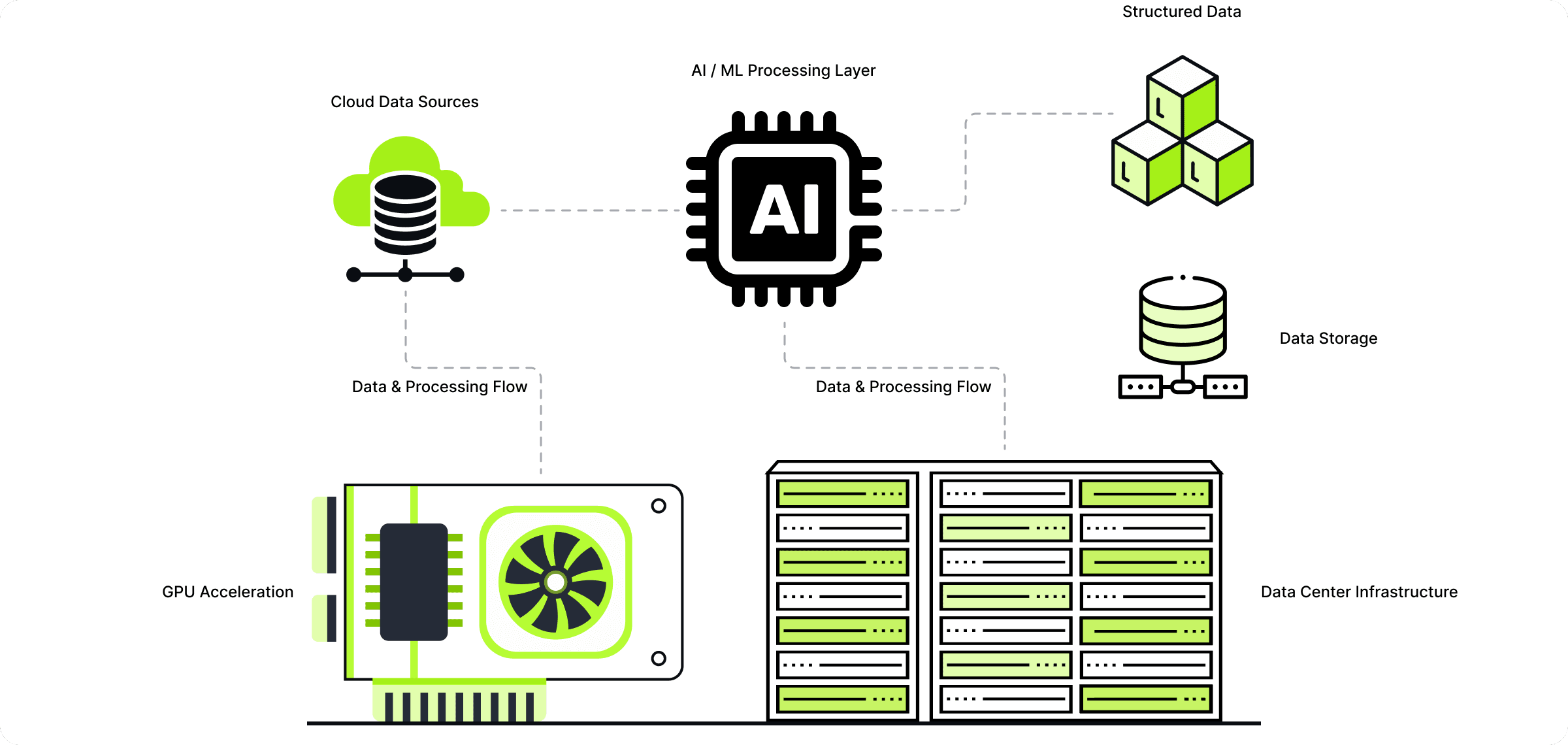
To begin with, developing a sovereign AI strategy starts with a finely honed GPU backbone. This is, of course, much more than just owning a set of GPUs; it's about designing and managing them for maximum utilization.
CoreWeave GPU Scaling
The role of CoreWeave and the emergence of specialized bare-metal cloud partners is a very significant one in the realm of providing a viable solution for organizations that are keen on attaining sovereignty.
Rapid Access to State-of-the-Art GPUs: Instant access to the latest NVIDIA GPUs, i.e., the H100 and A100, is available on a much greater scale than with general-purpose hyperscalers.
Cost Efficiency: High-end GPUs are made accessible at very competitive rates, especially for longer training sessions.
Specialized Infrastructure: Environments optimized for AI and ML are made available, resulting in significant reductions in setup time and increased performance.
Governance Flexibility: Despite being a hosted solution, dedicated instances offer a level of control much closer to that of a private solution, aligning with the concept of sovereignty.
By leveraging a solution like CoreWeave's, organizations can scale up immensely without requiring a massive capital outlay to build and maintain large GPU infrastructures.
Kubernetes GPU Orchestration
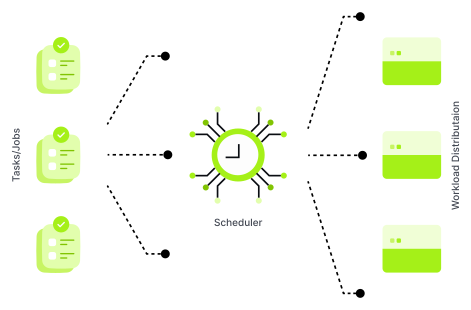
Managing distributed GPU clusters efficiently is a monumental task. This is where Kubernetes GPU orchestration becomes indispensable. Kubernetes, the de facto standard for container orchestration, offers powerful capabilities for AI workloads:
Resource Management: Intelligently manages resources across containers and services.
Scalability: Intelligently manages resources across containers and services.
High Availability: Provides automatic restart of failed containers.
Workload Isolation: Provides isolation between multiple AI workloads running on the same hardware.
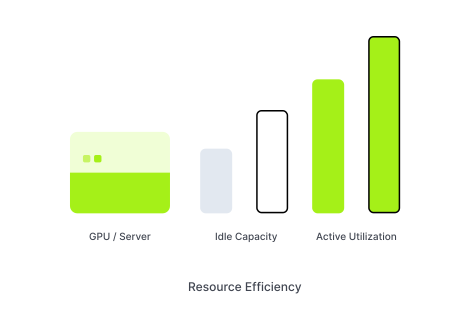
With Kubernetes, organizations can build a cloud-native AI infrastructure that is highly scalable and easy to use. It ensures efficient GPU use and optimizes associated costs.
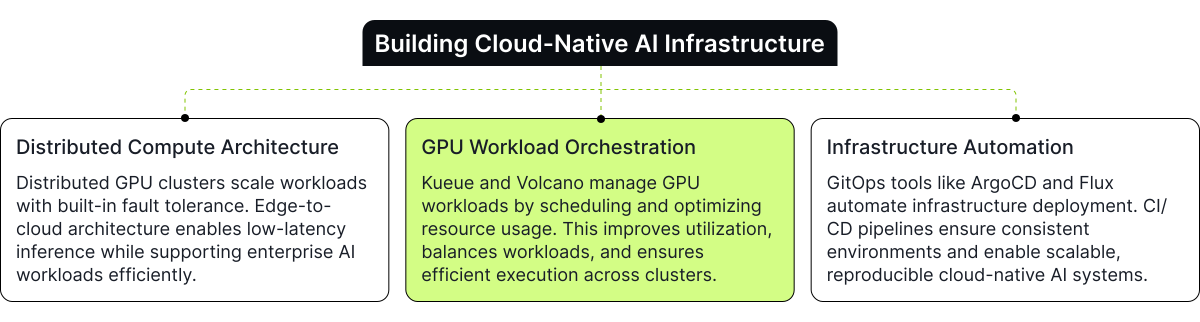
Building Cloud-Native AI Infrastructure
Cloud-native architectures are intended to be resilient and automated in building AI infrastructure for enterprises.
Real-World Use Cases and Applications
The benefits of sovereign and GPU-optimized AI systems offer a vast range of possibilities for businesses across content creation, security, and scale.
GPU-Accelerated Media Pipelines
In the media and entertainment industry, the exploitation of GPU technology in media workflows is transforming how media is created, processed, and delivered. The main areas of change are:
High resolution encoding/transcoding
Accelerating 4K/8K encoding/transcoding for streaming and delivery.
3D rendering and animation
Significantly reduced rendering time for complex 3D visual effects and animations.
AI-assisted media creation
Using generative AI for the creation of virtual media objects, voiceovers, and scenes.
Real-time video analytics
A critical component in sports broadcasting, surveillance, and quality monitoring.
Sovereign infrastructure ensures secure handling of highly valuable creative assets and proprietary AI models used in these pipelines.
Enterprise AI Model Training
The development of AI models is a critical area where training enterprise AI models benefits significantly from GPU clusters.
Large Language Models (LLMs)
Training foundation models requires a large number of GPUs and a high-speed interconnect.
Computer vision models
Developing custom image recognition, object detection, and facial recognition models.
Drug Discovery
Accelerating research in life sciences through faster data analysis and model-driven experimentation.
Scientific Simulation
Enabling complex simulations and large-scale data processing for advanced research and analysis.
The security of the training data and the AI model is critical for maintaining a competitive advantage in these areas.
Real-Time Inference Systems
For production deployment of AI models for real-time inference, low latency and high throughput are essential.
Fraud Detection
Enable instantaneous checks to prevent financial fraud through real-time monitoring and risk analysis.
Personalization Engines
Deliver immediate and personalized product suggestions based on user behavior and preferences.
Autonomous Systems
Interpretation of sensor data for self-driving cars or robots to make decisions in an instant.
Natural Language Processing (NLP)
Enable real-time conversational AI, sentiment analysis, and language translation for improved customer interactions.
The sovereign infrastructure ensures that these critical applications have the necessary resources allocated and remain within the strict boundaries of security and compliance.
How Radiansys Helps Enterprises Build Sovereign AI Infrastructure
Building and maintaining AI infrastructure is an intricate task that requires expert knowledge. Radiansys helps enterprises navigate the complexities of building AI infrastructure and provides solutions that meet their needs.
AI Infrastructure Architecture
Radiansys excels in creating robust AI infrastructure. Our approach to creating AI infrastructure involves the following steps:
- Needs Assessment: Identify AI requirements along with data privacy and regulatory needs.
- Strategic Planning: Developing a strategy to transition to sovereign AI infrastructure.
- Hybrid Cloud Integration: Design architecture integrating on-prem, private cloud, and GPU cloud platforms.
- Security by Design: Embed security and data governance from the start to protect intellectual property.
GPU Cluster Optimization
We can optimize your GPU resources so that they can function at optimal levels through expert GPU cluster tuning:
- Hardware Selection: Refer to the optimal combinations of NVIDIA GPUs and interconnects for your specific use case.
- Software Stack Configuration: Fine-tuning your OS, drivers, CUDA, and AI frameworks.
- Performance Tuning: Identifying and fixing any issues in your storage, networking, and compute stacks.
- Load balancing and Scheduling: Implementing advanced Kubernetes-based GPU orchestration.
Scalable Cloud-Native Deployments
We implement scalable, cloud-native AI systems that can meet our clients' high-performance and high-scale AI and data-driven applications, including:
- Containerization Strategy: Helping you containerize your AI applications for portability and efficiency.
- Kubernetes Implementation: Can implement and manage production-grade Kubernetes clusters that are optimized for GPUs.
- Automation Pipelines: Can implement continuous integration and continuous delivery pipelines that can support your AI and data-driven applications.
- Monitoring and Observability: Can implement monitoring and observability tools that can track and analyze your AI and data-driven applications.