
Concurrency, not completion
Thousands of concurrent requests mean that one large model is equivalent to thousands of small workloads.


The economics of enterprise AI have shifted dramatically. While the year 2023-2024 has seen organizations compete to train foundation models, 2026 brings a new set of challenges: how to scale LLM inference to production levels without draining capital.
The cost of running the 70B parameter model with thousands of concurrent users far exceeds the original training costs. This situation, combined with the ongoing GPU shortage, necessitates a strategic approach to optimizing GPU clusters that balances latency requirements, throughput rates, and infrastructure costs. This guide will discuss the technical framework for building scalable AI inference infrastructure using CoreWeave, Kubernetes orchestration, and hybrid GPU strategies.
The peak of the Intelligence Supercycle arrives in 2026, when generative AI shifts from innovation to industrialization. However, the physics of supply is not keeping pace with demand ambition. LLMs have progressed from scientific study to core enterprise applications, where demand for inference compute far outstrips training cycles. CIOs and platform strategists are under unprecedented pressure to sustain high-performance inference across millions of queries, all while facing a GPU shortage and thin margins.

The core problem lies with the "Big GPUs and Thin Margins" economy. Compute costs are dominating AI businesses, and even the most advanced data centers are optimizing for efficiency per watt. Optimizing GPU clusters for inference has become the new currency of competition that unlocks higher concurrency, better utilization, and lower cost per token.
Training was once considered the technical peak of an AI team's capabilities, but in 2026, inference is what defines sustainability. This means each LLM, from a personal RAG assistant to a multi-billion-parameter generative model, runs continuously, processing thousands of low-latency requests.
The economics of inference are quite different from those of training:
Thousands of concurrent requests mean that one large model is equivalent to thousands of small workloads.

Every millisecond counts, particularly in chat interfaces and retrieval-augmented applications.

While training might max out your GPUs, inference must cope with unpredictable loads.
Optimizing inference requires distributed GPU scheduling, hybrid scaling approaches, and smarter model serving pipelines.
In this environment of constrained resources, CoreWeave is an interesting solution: a dedicated cloud solution for large-scale AI inference on GPUs. Unlike other cloud providers, CoreWeave's distributed architecture is particularly well-suited to AI applications.
Key advantages:
Cost optimization insight: For organizations looking to manage costs, the CoreWeave GPU scaling feature provides the ability to implement "just-enough" infrastructure, which is ideal for creating GPU pods for active inference workloads and aligns perfectly with the FinOps movement.
A strong infrastructure for AI inference involves the following components:
The core of the infrastructure is the serving engine, which is implemented by frameworks like vLLM, TensorRT-LLM, and Triton Inference Server, which are specifically designed for inference in LLMs. These frameworks provide high-end features like paged attention and continuous batching to optimize the inference rate on the GPU.
Standard L7 load balancers are insufficient. Traffic must be routed intelligently based on GPU availability, model locality, and current worker capacity to prevent request queues from overwhelming individual model replicas.
In order to deploy models that are too large to be processed by a single GPU, the infrastructure must support distributed inference. This involves the implementation of pipeline parallelism, which divides the layers of the model between the GPUs, and tensor parallelism (splitting individual operations), which divides the operations of the model between the GPUs, using a high-speed interconnect.
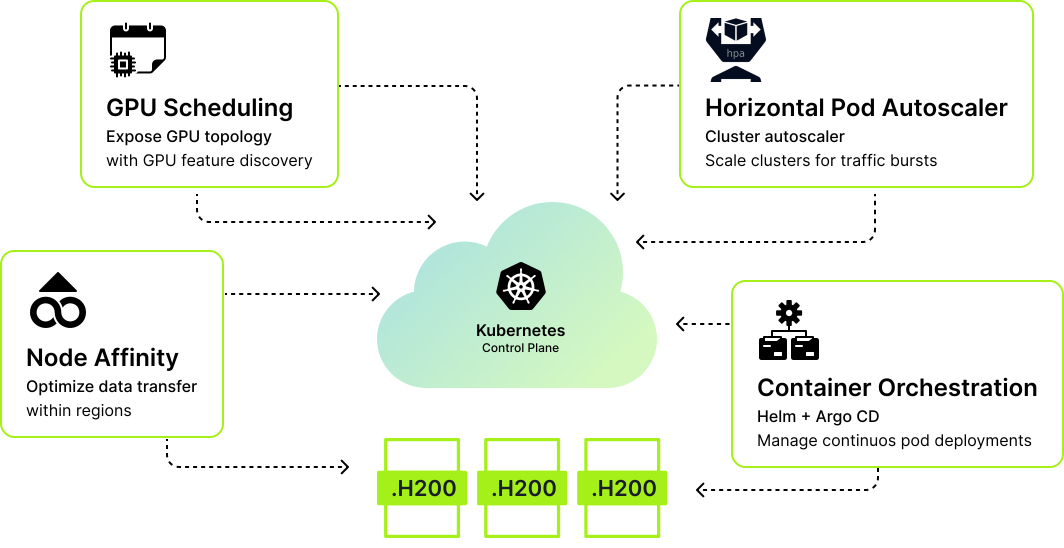
Kubernetes continues to be the foundation for orchestration in production environments for Artificial Intelligence workloads. For Kubernetes GPU orchestration, optimization is determined by how effectively you manage node scheduling and multi-tenancy.
Best practices for distributed GPU clusters:
GPU Scheduling: Utilize device plugin (NVIDIA Device Plugin + GPU Feature Discovery) to expose the topology.
Autoscaling: Utilize Horizontal Pod Autoscaler (HPA) + Cluster Autoscaler to scale based on traffic bursts.
Node Affinity: Schedule containers near model weights within the same region to optimize data transfer latency.
Container Orchestration: Utilize Helm + Argo CD for continuous deployment of pods across available GPU resources.
Using Kubernetes to abstract hardware allows teams to focus on implementing inference-optimization logic.
While architecting is half the battle, executing the model is the other half.
Inference Batching: Dynamic batching groups all incoming requests together and processes them together. This is very arithmetic-intensive and maximizes GPU usage.
Quantization: Quantization is reducing the precision of the weights in the model. This reduces the memory footprint of the model (optimizing GPU memory usage), which can speed up computation and allow for more parallel processing of requests.
KV Cache Optimization: The KV cache is one of the largest consumers of GPU memory during inference. Paged attention (popular libraries like vLLM) optimizes this cache and prevents memory fragmentation to allow for much higher batch sizes.
Trade-Offs: Larger batch size increases throughput but can increase latency. The right balance depends on your specific SLA and is a critical design decision.
FinOps for AI is no longer a finance afterthought but a core engineering discipline. In the 'Big GPUs, Thin Margins' world, maximizing GPU utilization is no longer a choice but a requirement for profitability or even survival.
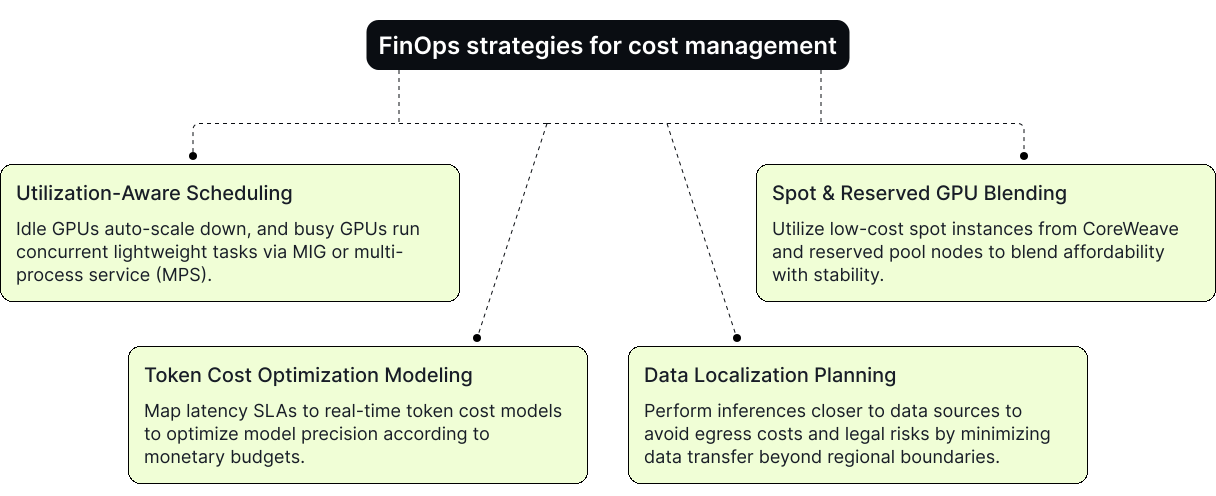
FinOps for generative AI is no longer a DevOps or finance task but a multi-disciplinary mandate where everyone shares dashboards, not spreadsheets.
Enterprises are increasingly embracing the concept of sovereign AI cloud strategies, which involve maintaining data and models in jurisdictional control. In the context of regionalized AI infrastructure, this translates to operating local GPU clusters with associated compliance frameworks.
Radiansys designs hybrid infrastructures with:
Such deployments balance performance, security, and sovereignty - the trifecta for enterprise LLM adoption.
Your AI workload orchestration strategy should incorporate a multi-cloud approach to minimize risk and maximize cost savings. Although CoreWeave is exceptional in terms of scalability and performance, specialized clouds like RunPod have their own importance.
The cost of using RunPod AI infrastructure for every GPU hour is highly competitive. This is a great alternative for development and experimentation purposes.
By using multiple GPU cloud providers, you can implement a burst compute strategy, scaling to a secondary provider when your primary cannot meet increased demand.
Radiansys combines its expertise in distributed computing, container orchestration, and GPU optimization to assist global enterprises in modernizing their AI infrastructure. Our model serving experts can develop containerized inference architectures for CoreWeave, RunPod, and hybrid cloud infrastructures. This helps to scale up infrastructure without incurring runaway costs.
Key Differentiators:

Custom topology designs for InfiniBand and NVLink-based GPU clusters.

Quantization, batching, and caching strategies for LLMs.

Secure, regionalized data and compute architectures.

End-to-end monitoring and spend modeling for GPU cost optimization.
For CIOs, this means having a secure, sovereign, and cost-effective LLM inferencing platform ready for 24/7 workloads.
Partner with Radiansys to design, build, and scale AI solutions that create real business value.