
Implementing Collaborative AI: A Guide to AutoGen for Enterprise Multi-Agent Decision Support

Introduction
In the 2026 Intelligence Supercycle, there is a scarcity of GPUs, high costs of computing, and data management, which make collaborative AI in the enterprise environment critical for scalable AI decision support systems. This guide is an introduction to AutoGen multi-agent systems as an essential framework for orchestrating enterprise AI, leveraging CoreWeave scaling, RunPod AI infrastructure, and Kubernetes GPU orchestration, with Radiansys enabling optimized deployments.
The Intelligence Supercycle & GPU Scarcity in 2026
The Intelligence Supercycle is the current state in demand for AI computing, which is accelerating at an unprecedented rate, far outstripping the global supply of high-end GPUs. This is not a temporary market fluctuation; it is the new economy in which any serious enterprise must operate. The result is a "Big GPUs and Thin Margins," in which AI infrastructure costs can erode business margins if not managed precisely.
Key challenges shaping enterprise AI adoption today include:
Compute Scarcity & GPU Cost Inflation
Accessing the best GPUs (such as NVIDIA's H100/H200 and the latest variants) remains competitive yet expensive, prompting leaders to seek the most efficient utilization strategies.
Regionalized Data Governance
With the rise of the GDPR and the growing need for data nationalization, the data processing often occurs within specific geographic boundaries, which defeats the purpose of having a universal cloud for large enterprises.
Hybrid and Multi-Cloud Complexity
In the pursuit of vendor lock-in, cost savings, and regional data governance, large enterprises are increasingly adopting a mix of public clouds, specialized AI clouds, and on-premise AI environments.
For the successful adoption of AI, however, a compute-efficient strategy is the need of the hour, which brings us to the new paradigm of collaborative AI for the enterprise, a much smarter approach for the new world.
The Rise of Collaborative AI & Multi-Agent Enterprise Systems
Collaborative AI for business extends the concept of individual chatbot conversations to the much more powerful enterprise-level agentic systems, in which many agents, powered by individual LLMs, come together to form the overall AI decision framework. This model excels for enterprise-level AI-driven decision intelligence systems that require dynamic workflows such as supply chain optimization and real-time fraud detection, where agents debate, iterate, and execute code collaboratively.
This model, which allows for the discussion and eventual execution of code, stands in stark contrast to the linear execution of the traditional enterprise architecture, wherein the Researcher Agent collects data, the Analyst Agent validates the results, and the Coordinator Agent integrates the results with human-in-the-loop (HITL) for the eventual decision-making process.
In environments with limited GPU resources, multi-agent systems are notable for their ability to integrate and coordinate AI workloads. Just imagine agents operating side by side, connected through a network of GPUs, reducing latency as they work together. These multi-agent systems for AI-driven workflow automation integrate with enterprise systems via APIs, enabling enterprises to leverage AI to schedule workflows across hybrid and multi-cloud hosting.
Adoption metrics: By the first quarter of 2026, approximately 65% of Fortune 500 enterprises would be testing multi-agent systems, based on Gartner-like analogs, resulting in a 40% ROI in decision latency for operations intelligence.
AutoGen for Enterprise Decision Support: Orchestrating Expertise
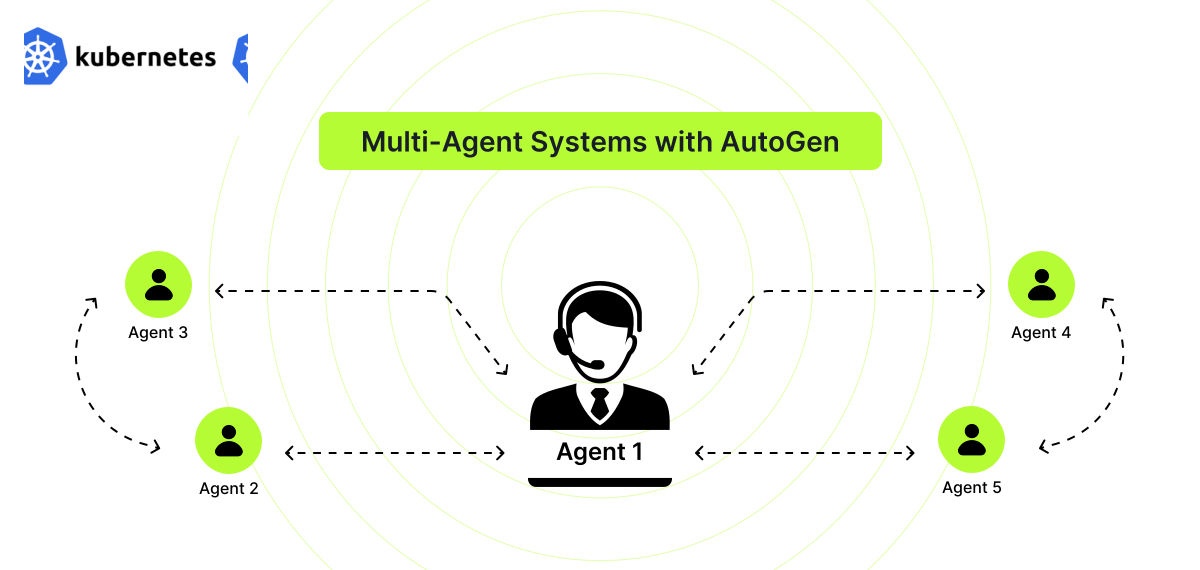
Microsoft AutoGen is an open-source framework that simplifies the creation and orchestration of AutoGen multi-agent systems. This AutoGen framework helps developers build a team of conversational agents that can interact with other agents and humans to accomplish the desired task.
At its core, AutoGen allows developers to define different agent personas and roles. For example, for a financial analysis task, the following agents could be designed:
- Data_Ingestion_Agent: It is responsible for pulling financial data from APIs and internal databases.
- Quantitative_Analysis_Agent: It would be an agent that can run code and apply statistical models to the ingested data.
- Risk_Assessment_Agent: It would be trained on risk frameworks and regulatory requirements to evaluate the analysis.
- Reporting_Agent: It would synthesize the findings into a human-readable CIO brief.
- Human_In_The_Loop_Proxy: It would temporarily stop the process and request approval from the human manager.
This capability to automate sophisticated workflows makes AutoGen a powerful foundation for developing next-generation decision support systems for enterprises. However, the framework itself is only part of the equation; the real game-changer for enterprises is the GPU infrastructure that drives AI workloads.
Implementing GPU-Orchestrated Multi-Agent Systems with AutoGen
The following provides a high-level overview of deploying a containerized multi-agent workflow using AutoGen on a Kubernetes-based hybrid GPU cloud.
Data_Ingestion_Agent and agent packaging
Each agent's role and logic are defined using the AutoGen SDK in Python. Each agent, along with its dependencies and models, is packaged into a separate container image, ensuring it is self-contained and portable.
Kubernetes Deployment Specs
Kubernetes Deployment or StatefulSet manifest (.yaml) files are created for each agent container. Within the resources section of each container's manifest, the necessary GPU resources (e.g., nvidia.com/gpu: 1) are requested, allowing the Kubernetes scheduler to place the pod on a node equipped with a GPU.
Infrastructure Abstraction with Node Labels
Kubernetes nodes are labeled based on their cloud provider and capabilities to abstract the underlying infrastructure.
- On-premise nodes can be labeled
cloud-provider=onprem, security-level=high. - Nodes in a RunPod environment can be labeled
cloud-provider=runpod, gpu-class=cost-effective.
Scheduling of the Workload
Kubernetes nodeSelector is used in each agent's deployment specifications to direct agents to specific nodes that match their business needs.
- The Quantitative_Analysis_Agent, which requires substantial power, is scheduled to nodes with the
gpu-class=high-performancelabel. - Reporting_Agent Runs periodically, scheduled to
gpu-class=cost-effectivenodes to optimize costs. - An agent handling sensitive PII data can be forced to run on security-level=high on-premise nodes to ensure data residency.
This structure directly maps business goals such as performance, cost, and compliance to automated infrastructure decisions, setting the stage for a truly compute-efficient AI system.
Sovereign AI & Regionalized IT Strategy
Sovereign AI cloud infrastructure is dominating in 2026, with 70% of EU companies requiring data-residency AI deployments. AutoGen deployments utilize private model hosting within regional AI compute clusters, i.e., CoreWeave EUWest2 zones that comply with GDPR.
Enterprise AI compliance architecture includes:
- Encryption: Agent data in-transit (TLS 1.3), at-rest (Azure Disk Encryption).
- Audit Logging: Vectorized traces to ELK stacks.
- Federation: Multi-cloud with RunPod's EU pods + on-prem via Kubernetes GPU orchestration.
Radiansys provides regional IT landscapes by mirroring agents to achieve data residency while maintaining latency below 50ms.
FinOps for Multi-Agent AI Deployments
FinOps for AI focuses on managing AI infrastructure costs effectively within a multi-agent AI scenario. Core principles include:
Compute-efficient AI systems
Agents are sharded to minimize VRAM from 80GB to 20GB per agent.
AI workload FinOps strategy
Auto-scaling via Keda and CoreWeave metrics to achieve 70% GPU utilization.
GPU Cost optimization
Spot bidding via RunPod to achieve 40% cost savings with fallback to reserved instances.
| Metric | Baseline | Optimized (AutoGen + K8s) | Savings |
|---|---|---|---|
| GPU Hours/Decision | 0.01 | 0.003 | 70% |
| Cost/Month (8xH100) | $25k | $12k | 52% |
| Utilization | 45% | 88% | +43% |
Track via cost-aware model orchestration, integrating OpenCost with AutoGen metrics.
Enterprise Use Cases
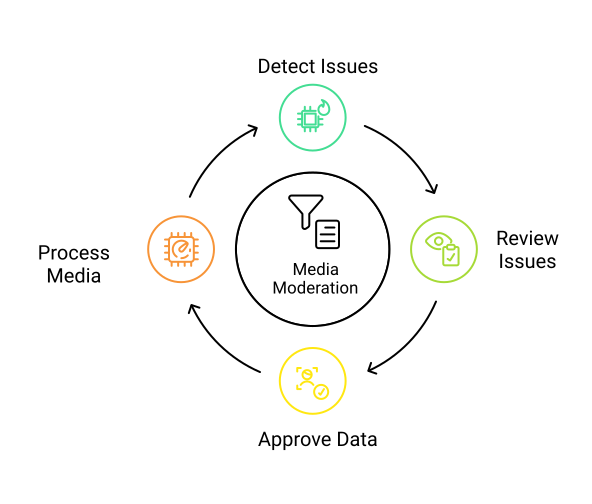
GPU Accelerated Media Pipeline
Media companies utilize AutoGen for content moderation. Here, VisionAgent uses GPU-accelerated CLIP to detect issues, EthicsAgent performs the review, and ApproverAgent sends the data to a human. The GPU-Accelerated Media Pipeline on CoreWeave processes 1 million frames/hour while meeting regional regulatory requirements.
Operations Intelligence
In the supply chain industry, PlannerAgent predicts requirements, OptimizerAgent performs simulations (using PuLP on CodeExecutor), and ExecutiveAgent provides the go-ahead signal. AI-based decision intelligence reduces inventory costs by 25% for enterprises with a hybrid AI cloud solution.
Fraud Detection
In the finance industry, DetectorAgent performs scans, InvestigatorAgent performs correlations, and ComplianceAgent generates reports. AI systems for enterprises with human-in-the-loop achieve 98% precision.
Why Radiansys for Enterprise Collaborative AI Implementation
The obstacles are real, and they're significant. Designing the multi-agent system, containerizing workflows, creating a hybrid cloud Kubernetes solution for GPUs, ensuring data sovereignty, and managing the entire operation with strict FinOps practices are all part of the equation.
This, however, is exactly where Radiansys can add value.
While we are certainly cloud resellers and consultants, we're also enterprise-level AI infrastructure architects who live and breathe the systems described in this guide. Our expertise lies in the intersection of AI workload orchestration, distributed GPU clusters, and FinOps for AI.
While AutoGen, CoreWeave, and Kubernetes are powerful tools, Radiansys brings the strategic guidance and executional engineering prowess to actually get them to work together towards your business objectives. We can provide the systems that thrive in the harsh world of "Big GPUs and Thin Margins" by:
Designing hybrid cloud infrastructure for enterprise-grade AI clouds, configuring your Kubernetes control plane to seamlessly orchestrate workloads across your CoreWeave, RunPod, public cloud, and on-premise hardware.
Optimizing the infrastructure for the best possible performance-to-cost ratio, leveraging our expertise in Kubernetes GPU orchestration and containerized workflows.
Designing the infrastructure with robust governance and implementing patterns for sovereign AI and data residency, making these native strengths of your AI infrastructure.
We enable your teams to focus on building high-value AI agents, while we ensure the underlying infrastructure is scalable, efficient, and economically sound.
Future Outlook: Compute-Aware Decision Intelligence Systems
The direction enterprise AI is taking is towards systems that not only understand their environments but also respond to them. Looking ahead, the direction that multi-agent systems will take is:
Adapt Dynamically to Compute Availability: Agents will adjust their behavior based on real-time infrastructure state, using faster/cheaper approaches when compute is constrained, leveraging more capable models when resources are available.
Optimize Across Heterogeneous Infrastructure: Multi-agent orchestration will natively span cloud, edge, and on-premises resources, automatically routing workloads to optimal locations based on latency, cost, and data-residency requirements.
Integrate Financial Awareness: Decision systems will incorporate cost as a first-class consideration, adjusting inference strategies based on budget constraints and value-at-stake for specific decisions.
Enable Collaborative Intelligence Networks: Enterprises will expose agent capabilities to trusted partners, creating networks of collaborative intelligence that span organizational boundaries while maintaining governance and control.
The enterprises that lay the groundwork for collaborative AI today, including creating multi-agent systems, leveraging the best of current AI workload orchestration, and developing a FinOps discipline focused on AI, will be the ones to benefit.
Your AI future starts now.
Partner with Radiansys to design, build, and scale AI solutions that create real business value.